
Labs4Nature methodology
Labs4Nature helps practitioners work more strategically with the people, systems and values that shape Nature-based Solutions.
The methodology combines the Three Spheres of Transformation framework with practical guidance for designing labs, selecting methods and evaluating learning.
From good solutions to lasting change
Nature-based Solutions can respond to multiple environmental and social challenges at once, but their success depends on more than technical design. Governance structures, relationships, power, values and assumptions all influence what solutions are considered possible, desirable and acceptable.
Labs4Nature brings these dimensions into the process from the beginning, helping practitioners create conditions for more inclusive and transformative change.
Working across three spheres of transformation
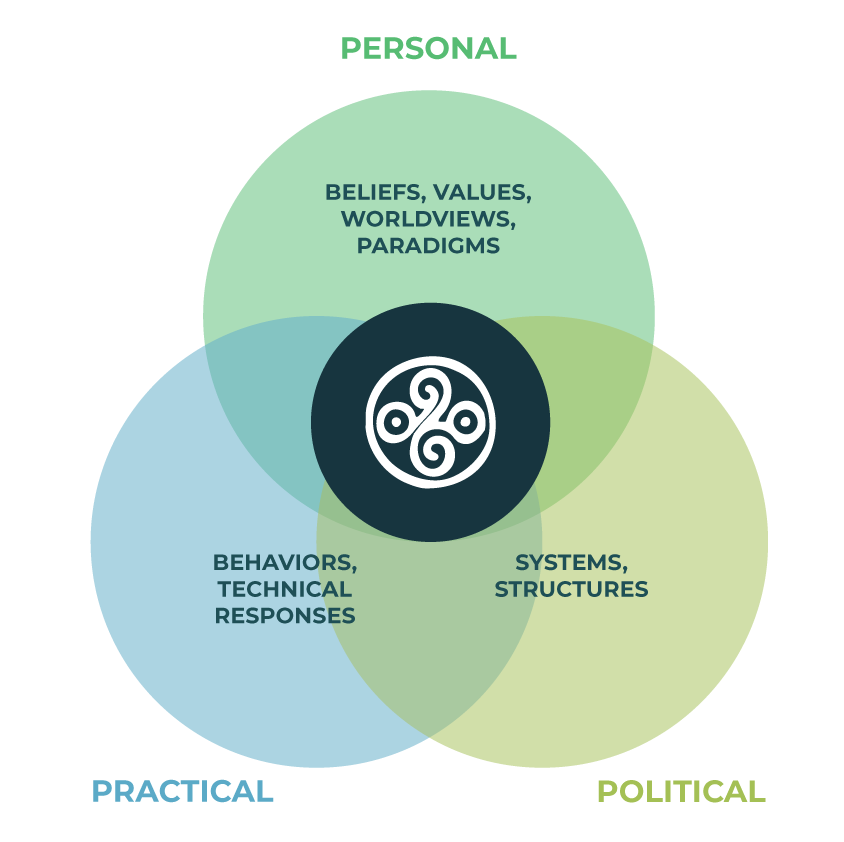
Labs4Nature uses the Three Spheres of Transformation as a framework for understanding where change happens and how different dimensions of a challenge are connected.
Practical
Actions, behaviours, technologies and concrete interventions.
Political
Policies, institutions, governance structures, social norms and systems that enable or constrain change.
Personal
Values, beliefs, assumptions and worldviews that shape how challenges are understood and how people act.
The three spheres are not separate stages. They interact continuously.
A practical solution may depend on changes in policy or governance, while both can be influenced by underlying assumptions about nature, responsibility and what kind of future is desirable.
Labs4Nature therefore encourages practitioners to ask not only what should we do?, but also:
- What systems are shaping the current situation?
- What assumptions or values influence the way the challenge is understood?
- What needs to shift for a solution to create lasting change?
Turning the methodology into a process
Labs4Nature labs are collaborative spaces for exploring complex social-ecological challenges and developing pathways towards more equitable, sustainable and nature-positive solutions.
They bring together different actors, perspectives and forms of knowledge — not only to develop possible interventions, but also to understand the relationships, systems and values that shape the challenge.
Labs4Nature combines two lab traditions:
– Living Labs contribute experimentation, real-world testing and a strong orientation towards action.
– Transformation Labs bring deeper reflection on systems, agency, justice, relationships and the conditions for transformative change.
The result is a process that connects practical experimentation with reflection and systems thinking.
More than a single workshop
A Labs4Nature lab is best understood as a facilitated process that develops over time. Rather than moving immediately towards solutions, the process creates space to build relationships, understand what matters and explore the challenge from different perspectives. It can be organised around three broad phases.
Trust, values and relationships
The first phase creates a foundation for collaboration. Participants get to know one another, explore individual and shared values and begin to understand the perspectives, assumptions and experiences present in the group.
The aim is not to create agreement on everything, but to establish enough trust and shared purpose for constructive collaboration.
Challenges and what is at stake
Participants then explore the challenge in greater depth. They consider how the problem appears in practice, what systems and relationships contribute to it, who is affected and what may be at stake if existing approaches continue.
Nature itself can also be brought explicitly into the process as a perspective or stakeholder.
Pathways and solutions
Only then does the process move towards concrete interventions and possible pathways forward. Participants return to the values, relationships and understanding developed earlier and ask what kinds of solutions could respond to the immediate challenge while also supporting longer-term human and ecological wellbeing.
The key principle is simple: do not rush to solutions.

Designing a Labs4Nature process
Good lab design begins before choosing workshop methods. The first task is to understand the challenge, the people connected to it and the wider context in which change needs to happen.
Labs4Nature therefore encourages organising teams to consider:
– Who is directly affected?
– Who can influence possible solutions?
– Who holds relevant local, professional or experiential knowledge?
– Whose perspectives are usually missing?
– What power differences or conflicts may shape participation?
– How can more-than-human perspectives be represented?
– What can participants genuinely influence through the process?
Stakeholder analysis is not only a recruitment exercise. It helps the team understand relationships, gaps in representation and dynamics that may later shape the lab itself.